
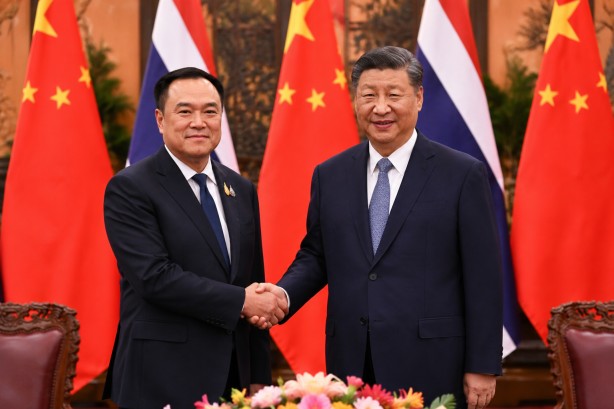
In a significant meeting held in Shanghai, Chinese President Xi Jinping and Thai Prime Minister Anutin Charnvirakul committed to bolstering the bilateral relationship between their nations. The discussions centered on enhancing cooperation in cutting-edge sectors such as artificial intelligence, aerospace, and clean energy. Both leaders expressed their intent to accelerate key infrastructure projects, notably the China-Thailand railway and the rail links connecting China, Laos, and Thailand.
President Xi and Prime Minister Anutin underscored the importance of regional cooperation and pledged to work closely on various fronts, including tackling cross-border crimes. They highlighted the need for joint efforts to combat issues like online gambling and telecommunications fraud, which have posed significant challenges to both countries. The meeting also emphasized the potential for collaboration in tourism, education, and media sectors, aiming to foster a stronger partnership between the two nations.
Furthermore, Thailand reiterated its adherence to the one-China policy, reinforcing its diplomatic stance in line with China’s expectations. This affirmation is a critical aspect of the bilateral ties, reflecting mutual respect and understanding in their diplomatic engagements. Both leaders stressed the importance of addressing regional challenges through peaceful means, with particular attention given to the ongoing situation along the Thailand-Cambodia border.
The discussions also touched upon the broader implications of their partnership, considering the strategic significance of their collaboration in the context of Southeast Asian geopolitics. By focusing on infrastructure and technological advancements, China and Thailand aim to set a precedent for regional development and connectivity, which could have lasting impacts on economic growth and stability in the region.
This meeting in Shanghai marks a crucial step forward for China and Thailand as they seek to deepen their strategic partnership. The commitments made by both leaders highlight their shared vision for a future that leverages technological innovation and regional cooperation to address both bilateral and broader regional challenges effectively.